

The Caduceus Learning Cycle
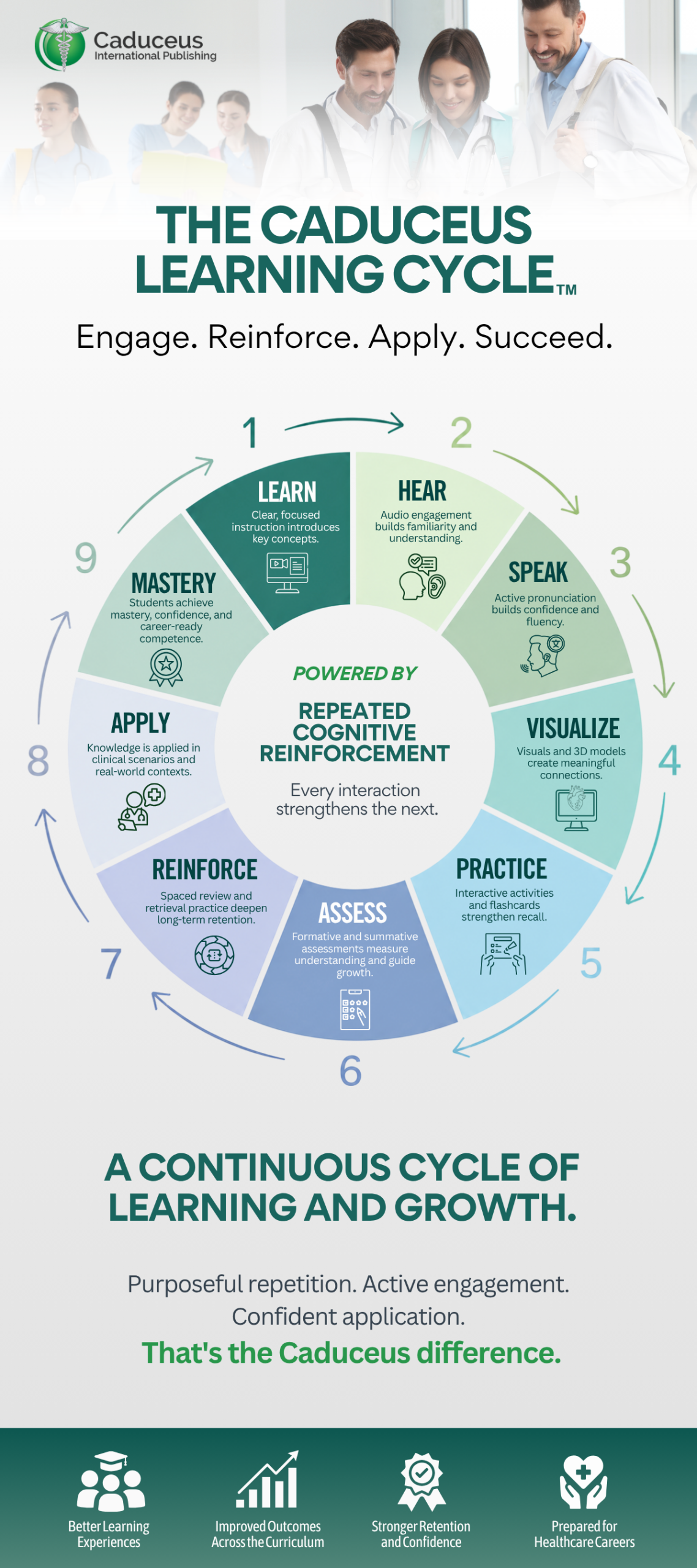
1. Learn: Building a Strong Foundation
2. Hear: Reinforce Learning Through Audio
3. Speak: Develop Confidence With Medical Language
4. Visualize: Make Meaningful Connections
5. Practice: Strengthen Recall Through Interaction
6. Assess: Check Understanding and Guide Growth
7. Reinforce: Return to Knowledge Over Time
8. Apply: Connect Knowledge to Healthcare Contexts
9. Mastery: Build Knowledge, Confidence, and Readiness
Educators, Get a Free 30-Day Trial
Submit the form below and we’ll be in touch shortly
(Teacher Use Only)
Differentiated Instructional Benefits
Move Beyond Multiple Choice
Traditional assessment questions often lack context. With interactive 3D assessments, you can test students knowledge in a much richer, spatial context.
Boost Student Engagement
It’s well established that 3D interactive content keeps students engaged. Better engagement on assessments can only lead to better results.
Improve Retention and Comprehension
Research has shown that interactive 3D content has a significant positive effect on learning, recall and test performance.
Powered by repeated cognitive reinforcement
Students encounter important concepts repeatedly through instruction, audio, pronunciation, visual learning, interactive practice, assessment, review, and application. This repeated cognitive reinforcement creates multiple opportunities to engage with the same knowledge in different ways and at different points in the course.
Instead of a traditional learn-test-move-on approach, the cycle keeps students actively interacting with course content.
That means learning becomes an ongoing process of:
1
2
3
4
5
Learning That Keeps Moving Forward
Students learn. They hear and speak. They visualize and practice. They demonstrate understanding, revisit important concepts, and apply what they know. Each experience builds on the last—and the cycle continues.
Purposeful repetition. Active engagement. Confident application.
Designed for health science education
The approach is designed to support:
Better learning experiences
Students interact with course material through multiple formats rather than relying on a single method of instruction.
Improved outcomes across the curriculum
Practice, assessment, reinforcement, and application are built into the learning experience instead of treated as separate activities.
Stronger retention and confidence
Repeated opportunities to retrieve and use knowledge help students continue working with important concepts over time.
Preparation for healthcare careers
Students progress from learning foundational concepts to applying knowledge in healthcare-focused scenarios and contexts.